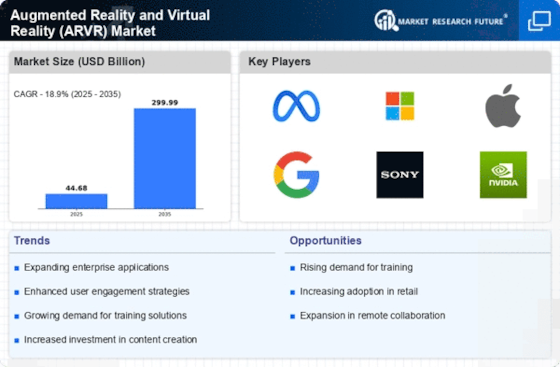
The Augmented Reality and Virtual Reality (ARVR) Market is currently experiencing a transformative phase, characterized by rapid advancements in technology and increasing adoption across various sectors. Industries such as healthcare, education, and entertainment are integrating AR and VR solutions to enhance user experiences and improve operational efficiency. This integration appears to be driven by the growing demand for immersive experiences, which could potentially reshape how consumers interact with digital content. Furthermore, the proliferation of mobile devices and advancements in hardware are likely to facilitate broader access to AR and VR applications, making these technologies more mainstream. The virtual reality industry is evolving rapidly, supported by strong investments, expanding use cases, and increasing enterprise adoption. Overall, the VR industry and augmented reality market are expected to play a central role in future digital transformation strategies.
In addition, the Augmented Reality and Virtual Reality (ARVR) Market is witnessing a surge in investment from both private and public sectors, indicating a strong belief in the future potential of these technologies. Companies are increasingly focusing on developing innovative applications that cater to diverse consumer needs, which may lead to the emergence of new business models. As the market evolves, it seems that collaboration between technology providers and end-users will be crucial in driving the next wave of growth, ensuring that solutions are tailored to meet specific demands and preferences. This collaborative approach could foster a more robust ecosystem, ultimately benefiting all stakeholders involved. The global augmented reality market and virtual reality market are expanding rapidly, driven by strong demand across gaming, healthcare, education, and enterprise applications. According to recent augmented reality stats, the ARVR market generated significant augmented reality revenue in 2024, reflecting the growing maturity of the virtual reality industry and the broader VR industry ecosystem.
Increased Adoption in Education
The integration of Augmented Reality and Virtual Reality (ARVR) technologies in educational settings is becoming more prevalent. Institutions are exploring these tools to create engaging learning environments that enhance student participation and retention. By providing immersive experiences, AR and VR can facilitate complex concepts, making them more accessible to learners. Advancements in augmented reality components, including sensors, processors, and display technologies, are enhancing performance and user immersion across AR applications. Leading augmented reality technology companies are investing heavily in R&D to develop advanced VR headsets that offer improved resolution, comfort, and real-time interaction. The rise of enterprise virtual reality solutions is transforming corporate training, remote collaboration, and industrial simulations.
Expansion in Healthcare Applications
The healthcare sector is increasingly leveraging AR and VR for training, surgical simulations, and patient treatment. These technologies offer innovative solutions that improve medical training and enhance patient care. The potential for AR and VR to visualize complex medical data and procedures suggests a promising future for their application in this field. The use of augmented reality for consumer exhibitions is increasing as brands adopt interactive digital experiences to engage audiences at trade shows and events. Many global augmented reality brands are leveraging augmented reality in consumer exhibitions to deliver immersive product demonstrations and personalized customer experiences.
Growth of Remote Collaboration Tools
As remote work becomes more common, the demand for AR and VR solutions that facilitate collaboration is rising. These technologies enable teams to interact in virtual environments, enhancing communication and productivity. The ability to simulate real-world scenarios in a virtual space may redefine how organizations approach teamwork and project management. The adoption of augmented reality for industry is accelerating in manufacturing, logistics, and maintenance, enabling real-time data visualization and workflow optimization. In parallel, enterprise virtual reality is being used for safety training, equipment simulation, and operational planning across industrial environments.